Solution
The Integrated Operations Model
You know what you stand for. Does everything around it work as well as it could?
Most mission-driven organisations work with specialists: a designer for the identity, a consultant for the strategy, a developer for the website, an agency for the campaign. Each delivers their piece. Nobody owns the whole.
The result is fragmentation: systems that pull in different directions, teams that depend on outside help for every decision, and organisations that spend more energy managing communications than doing their actual work.
The Integrated Operations Model is a different approach. Strategy, identity, digital infrastructure, and communications are conceived together, built together, and handed over as one coherent system. Complete. Ready to run. Independently.
What it looks like in practice
Nationale 4
From a blank WordPress and no identity to a fully operational, reader-funded investigative publication in four weeks.
Philippe Engels, co-founder of Médor and winner of the Trace International Press Prize, needed to launch an independent investigative media publication with a working paywall, a reader-funded monetisation model, and a visual identity that positioned it clearly in the Belgian media landscape. In four weeks: complete visual identity, web design, CRM architecture, audience segmentation, automated communication system, and launch campaign. The publication generated €1,167 in its first week, entirely through organic reach, with email open rates of 42–55% against an industry average of 20–25%.
Read the full case study

CARAVAN International
From fragmented member communications across 50+ organisations to a unified, deployable system used across 18 countries.
A Brussels-based international network needed to simultaneously strengthen internal coordination, build advocacy infrastructure, and respond to the cancellation of its flagship annual event. The response was a complete communication toolkit deployable across all member organisations, a reconceptualised digital event format that reached policymakers and funders for the first time, and the network's first systematic audience data for ongoing advocacy.
Read the full case studyÉcole de Cirque de Bruxelles
From unsustainable overcommitment to a communications infrastructure the team could actually run independently.
A Brussels circus school had communications systems it could not sustain: overcommitted social media, no reliable way to gather content across sectors, and no templates enabling teams to work autonomously. The work produced a sustainable newsletter infrastructure, a template system enabling decentralised content production across all sectors, and a youth influencer partnership reaching demographics no other Brussels cultural organisation had accessed.
Read the full case study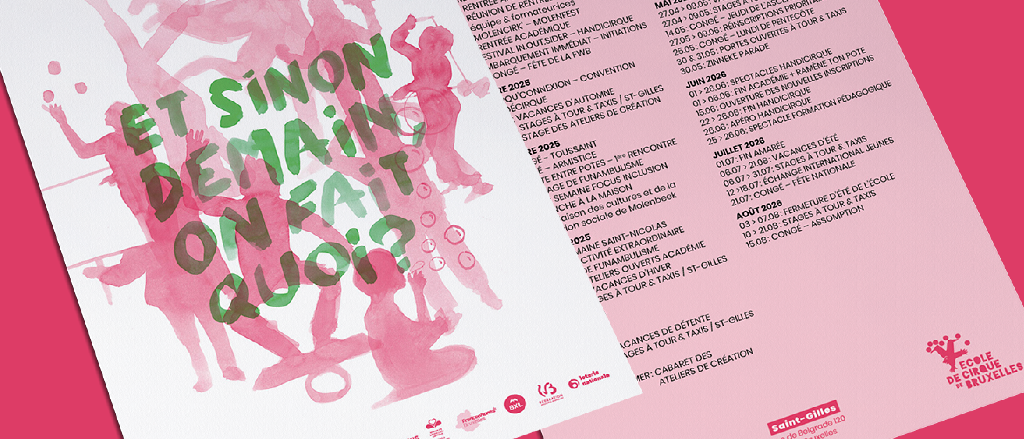
Three phases. One system.
Understand the terrain
Before anything is built, the space the organisation operates in is mapped: the cultural, editorial, and strategic context, the conventions that define it, and where a conscious choice to inhabit, adapt, or step away from those conventions creates advantage. For Nationale 4, this revealed the opportunity to root the identity in Belgian graphic culture. For CARAVAN, it exposed the sector invisibility problem. For École de Cirque, it produced the honest capacity assessment that led to abandoning unsustainable channels entirely.
Output: shared strategic clarity
Build the system
Execution covers four layers simultaneously, always.
Identity and voice
Logotype, typography, colour, messaging, style guide, asset library.
Digital infrastructure
CRM, audience segmentation, automated workflows, email systems.
Content architecture
Web design, email templates, editorial guidelines, content structure.
Audience strategy
Segmentation, targeting, partnerships, first-party data, measurement.
Activate and hand over
Every engagement ends the same way: a functioning system, a team equipped to use it, and full operational autonomy from day one. No dependency, no ongoing coordination required. The organisation briefs once. Everything else follows.
Output: complete operational independence
What this replaces
Instead of coordinating a branding agency, a strategy consultant, a web developer, a CRM specialist, and a campaign manager, each working from their own brief with no one owning the whole — you get one integrated system designed to function together from day one.
One point of contact. One brief. One coherent result.
This is not a larger engagement than working with specialists separately. It is a faster, more coherent, and more cost-effective one. Because the integration work — the part that usually falls between the cracks — is built in from the start.
The fragmented approach
Branding agency
Strategy consultant
Web developer
CRM specialist
Campaign manager
No one owns the whole
The integrated approach
One brief
One system
One point of contact
Delivered complete
Where to start depends on where you are.
Operational Launch
For organisations launching something new or relaunching something that has stalled. The full scope: positioning, identity, digital infrastructure, content architecture, audience strategy, and launch execution. One system, delivered complete.
4 to 8 weeks
Communications Infrastructure Build
For organisations that have a mission and an audience but no reliable system to connect them. Audit of existing channels and capacity, strategic refocus, CRM and email infrastructure, audience segmentation, automation, and templates for team autonomy. Built to match actual organisational capacity.
4 to 6 weeks
Identity System
For organisations whose visual and verbal identity no longer reflects who they are or where they want to go. Positioning research, visual identity creation or refresh, verbal identity and messaging, style guide and asset library. Designed for longevity and team autonomy.
3 to 5 weeks
Network & Multi-Stakeholder Communications
For organisations managing communications across multiple entities, geographies, or audiences simultaneously. Communication toolkit, messaging frameworks, template systems deployable across distributed teams, segmented audience strategy, advocacy infrastructure.
4 to 8 weeks
Campaign & Activation
For organisations facing a specific high-stakes moment: a launch, an event, a funding push, a public campaign. Concept, content strategy, multi-channel execution, measurement. Built to serve the immediate objective and leave lasting infrastructure behind.
2 to 4 weeks
The organisations this works for
Organisations that have tried the fragmented approach and found it exhausting. That have strategy documents gathering dust. That have hired specialists who each delivered their piece but left the integration problem unsolved.
Cultural institutions
Museums, theatres, festivals, arts organisations
Independent media
Editorial projects, investigative publications
NGOs & social enterprises
Mission-driven organisations with purpose and impact
Professional networks
Associations, federations, cross-sector bodies
Small teams
Three-person teams to mid-sized institutions
Multi-stakeholder orgs
Networks managing distributed communications
This scales to small teams. It is designed around real capacity, not ideal conditions. Three-person teams and larger institutions both benefit from the same approach: everything built to be run without outside help once delivered.
Brief once. Go back to your work.
Ready to talk about what you need?
Book a discovery call. Bring your situation, your constraints, and your goals. By the end of the call, you will know whether working together makes sense and what the right entry point is.
Start a conversationOr reach out directly at contact@adriane.studio